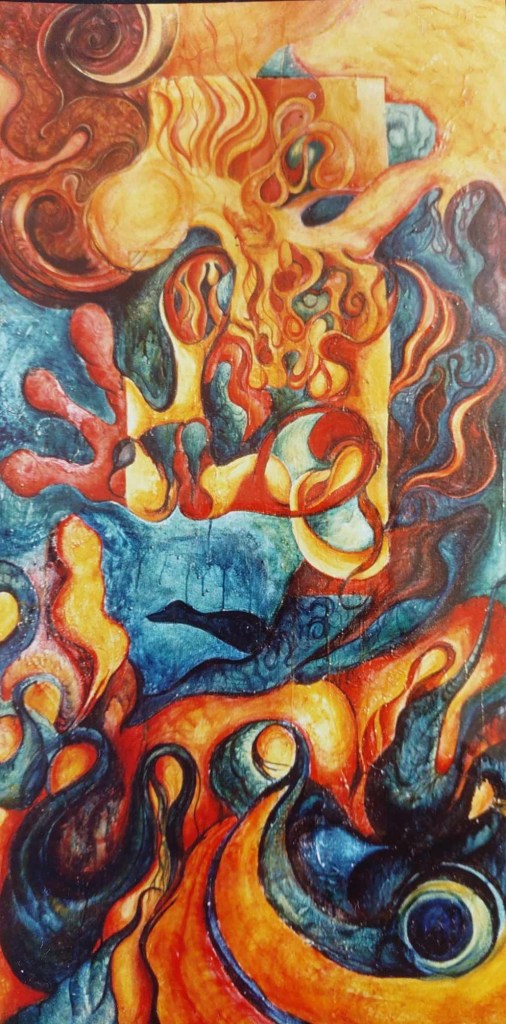
I’m participating in Hamilton’s PhD research into delusions. He asked me why I don’t like psychodynamic explanations of delusions and, if I don’t use these explanations, how do I make sense of my experiences? This is my response.
The idea behind psychodynamic explanations of delusions is that the delusions are not caused by a biological dysfunction. Instead, there is something about the person such as low self-esteem that leads to the delusion. Or, more formally, psychodynamic accounts suggest that delusions are formed by motivational factors. For example, “delusions of persecution would be developed in order to protect us from low self-esteem and depression and would be due to the attribution of negative events to some malevolent other rather than ourselves. The delusion would be part of a defense mechanism” (Bortolotti, 2022).
The reason I don’t like these approaches is that they suggest that delusions are the result of a character flaw in the individual. Consequently, they tend to blame the person with the delusions for what has occurred to them. They suggest that the person who has the delusion has a deficit and that, if they worked harder, they could overcome their weakness. For example, if I have the delusion that I’m the Second Coming, then this grandiosity is the result of my low self-esteem. The implication is that I am responsible for my delusion.
It’s unfair to blame a person who experiences delusions and to perceive them as being a lesser person for having these (imagined) character flaws. This leads to demonising people and is the basis of stigma. It can be random who experiences delusions, they can occur to anyone. It is wrong to judge a person who has these experiences as being morally inferior – and this is the implication if delusions result from a character flaw. On the contrary, those who experience delusions and psychosis are often brave and experience incredible trials. We should be celebrated, not demonised or stigmatised.
Another limitation of these psychodynamic explanations is that they do not acknowledge the experiences themselves, and the strength required to deal with them. Stating that low self-esteem resulted in my belief that I was the Second Coming misses the point. It ignores the phenomenology of the experience. These are profound experiences where we can identify with forces far greater than ourselves. To undergo these experiences then come out the other end requires strength. It can take decades to integrate these experiences. By reducing these experiences to psychodynamic explanations none of this is appreciated.
My experiences were deeply human experiences that held deeply human truths. They were experiences that tell us something about ourselves and society. They were archetypal and they need to be listened to, acknowledged, and respected. And somehow, we need to make sense of them. Although after thirty years I am still unable to do this.
If we reject psychodynamic explanations, then what can replace them? In the delusion literature, most theorists hold that delusions are caused by neuropsychological deficits. Neuropsychological approaches can suggest that a damaged region of the brain can cause the formation of a delusion. Other neuropsychological accounts suggest that unusual perceptual experiences cause delusions. Still other accounts suggest that, in addition to unusual perceptual experiences, people who experience delusions have a deficit when it comes to evaluating the beliefs they form (Bortolotti, 2022).
While neuropsychological approaches offer philosophical and scientific ways to understand the cause of delusions, does accepting that we have a physical dysfunction satisfy us if we want to answer the question ‘why did this happen to me?’ While some people may be content to accept that the cause of their delusions can be understood in reductive terms, others need spiritual answers to this question. And these answers – how we make meaning from our experiences – can sit side by side with philosophical and scientific approaches.
As a young person I was searching for a deeper understanding of myself. I don’t know why such big experiences – my psychotic episodes – happened to me. I don’t know what they were trying to tell me. But they moulded me into the person that I am and determined my path through life. This has been a path where I have sought to understand myself, what has meaning in life, and to understand the nature of reality. And while I have fallen short in many ways, I have nevertheless spent my life trying to become someone who I thought I should be. I have tried to be true to the path I was given via these experiences.
These experiences spoke to me of a reality much richer than the world I was supposed to value with its materialistic goals. And despite being shattered by these experiences and spending many years trying to pick up the pieces, the life that has grown out of these experiences is rich. My view of reality and the goals I set for myself continue to be shaped by these experiences. I remain motivated by the desire to make sense of what happened to me and this sense-making has been the quest of my life. And it feels like a life with purpose.
I was given these experiences as a gift. I cannot answer why I was given this gift. But I do know that these experiences were not a punishment. I was shown something about reality that I still believe is true and profound. It was precious and I value it above nearly all else. I don’t believe this is a desperate grab to make meaning from adversity. On the contrary, this explanation feels real to me – a true report of the value I attach to being allowed to see reality in such a raw and unveiled form.
Perhaps my brain is damaged. Perhaps I am sick. Or perhaps I am, like you, a child of the universe. And this has simply been my journey through life.
References: Bortolotti, Lisa, “Delusion”, The Stanford Encyclopedia of Philosophy (Summer 2022 Edition), Edward N. Zalta (ed.), URL = <https://plato.stanford.edu/archives/sum2022/entries/delusion/>
 Shauna Winram blog