Humanity has a long tradition of testing the soul, as reflected in the many initiations and rites of passage found in indigenous cultures. Initiations often involve trials or ordeals that test the initiate’s worth and ability. By overcoming these tests, the initiate transitions to a new phase in their lives. As well as being ubiquitous in indigenous cultures, many religious or mystical figures have reported undergoing tests in the service of deeper insight or unity with God. But it is not only mystics who are tested. The madman too can have experiences of being tested. How are we to understand the relationship between the tests of the mystics and those of people who experience psychosis?
In the following I outline various approaches to understanding mysticism, and its relationship to psychosis, with a view to shed light on this idea of being tested. But first, I discuss St Teresa of Avila to illustrate an example of a mystic who underwent numerous trials. Then, I discuss my own experience of being tested during psychosis. I suggest that the experience of the mystic and the madman are not so far removed. Both can be transformed by their encounter with an unveiled reality.
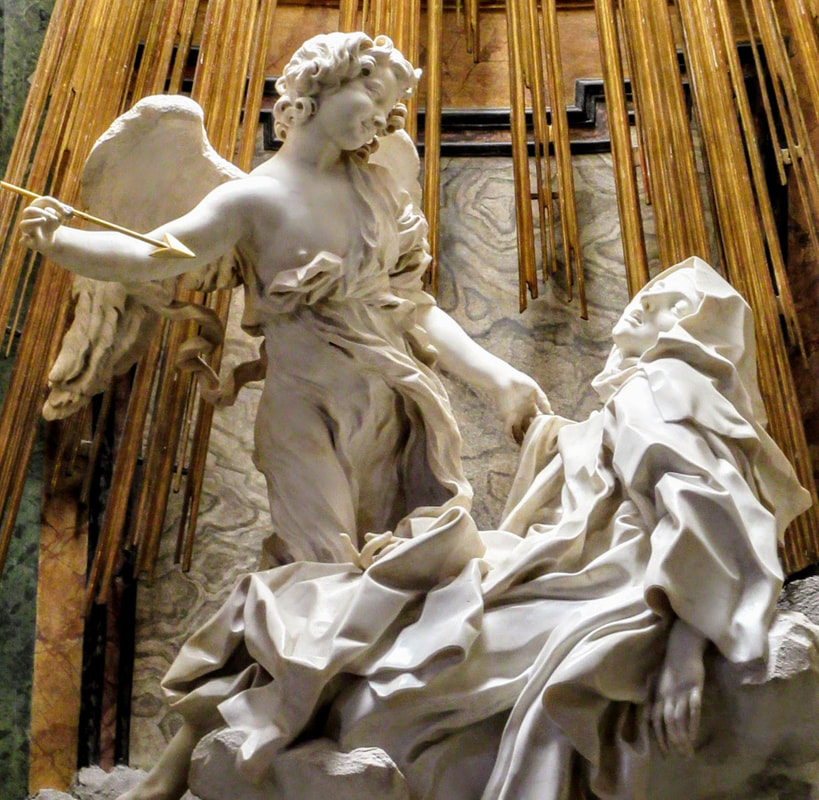
Teresa of Avila (1515-1582) was a Spanish mystic, writer, and monastic reformer. Her works include The Way of Perfection and The Interior Castle. These books describe her religious experiences and are important sources of Christian mysticism and spiritual guidance. She suffered severe illness during her life, and once fell into a coma. When she recovered, she remained paralysed for three years. Teresa was known for her visions, revelations, and raptures. From 1559 – 61 she was convinced that Christ, although invisible, was with her in bodily form. She is also well known for a vision where an angel drove the point of a fiery lance through her heart, causing both spiritual agony and joy. This episode was famously depicted in ‘The ecstasy of St Teresa’ by the sculptor Bernini (“Teresa of Avila,” 2023).
Teresa of Avila experienced a life of being tested and transformed. Her struggle with poor health, the persecution she endured due to her visions and reforms to the church, as well as the suffering she endured during periods where she felt abandoned by God, were part of a life where she was tested. Tests can present themselves to subjects in the service of transformation, and transformation is at the heart of The Interior Castle. In this text Teresa compares the contemplative soul to a castle that has seven interior chambers. As the spiritual practitioner progresses through each of these chambers, they move closer to God. (“Teresa of Avila,” 2023). Transformation in the life of Teresa of Avila can also be understood in the context of mystical death. Mystical death is a term used to describe a mystic’s transformation from self-centeredness to other-centeredness. In The Interior Castle Teresa uses the symbolism of a caterpillar turning into a butterfly to describe the “ascending of internal energies” (Gálik, Gáliková Tolnaiová, & Modrzejewski, 2020, p. 593).
I now turn to the experience of being tested during psychosis. In 1997, I wrote a play called Van Gogh’s Boots: A guided tour through psychosis that recounts my first psychotic episode that happened in 1991 when I was 21. I performed in this play with a friend. I acted as myself going through the experience, and my friend was the narrator, playing myself narrating the experience. The play recounts my journey from Tasmania (where I was visiting friends as my psychosis began) to Sydney, and the days I wandered around Sydney before being taken to a psychiatric hospital. The following is taken from this play and describes the moment when I became aware I was on a ‘mission’ and taking part in an initiation.
Narrator: I was on the night train back to Sydney. I could smell myself. An old woman sat behind me, across in the other aisle. She was a guardian angel. She had been sent to look out for me, to make sure I was okay. It felt good to know she was there. I felt protected. I knew that what I was doing was important. I knew I was on a mission. Then, suddenly I realised that this is an initiation. I’m doing an initiation test. They were watching me. The higher souls. I grabbed the Gideon’s Bible, which I had stolen from the ferry, and began to read Revelations.
The following lines describe my experience when I arrived in Sydney:
Shauna: Where do I go? Where do I go? They’re waiting for me. Where are they?
Narrator: This was part of the initiation. Part of the performance I was doing. I knew I was being watched. I had to find my way to the place where the ceremony was going to be held. I could see all the planes from all over the world which had come to Sydney. Each one carrying Elders from tribes all over the world. They had come to Sydney for my initiation. And part of the initiation was to find them.
(She starts following someone).
Shauna: Of course! The old woman. The guardian angel.
Narrator: I started to follow the old woman. But she half turned her head towards me, and I knew that I wasn’t to follow her. I had to find my own way.
Shauna: It’s a secret society. I must follow the signs to them. They are leaving me signs. Must be careful not be caught. Have to do the right thing. Have to pass the test.
Narrator: I walk out into the morning. It is early, there is hardly anyone around. My house is near Central Station, but I don’t feel that this is where I have to go.
The initiation that I believed I was undergoing was in the form of a test. After I arrive back in Sydney, I wandered around before returning to the share house that I lived in in Surry Hills. I was upset and a close friend who lived nearby took me to his place for the night. The following recounts this experience:
Narrator (as Ian): Come on, you can stay at my place.
Shauna: He knows. He knows I’m doing the initiation. I’m meant to go to his place. It’s really important. They are trying to protect me. There is good and evil in the city. It’s all up to me…
Narrator: I could feel the good and evil in the city. Everything was quiet. It was the calm before the storm…
Shauna: I’m really important. The outcome of this initiation is really important. It doesn’t just affect me.
Ian: Come on, Shauna. We’ll walk to my house.
Shauna: Yes. Yes, okay. He knows what’s going on. Ian is one of them. He is a vampire.
Narrator: We walked out into the street. It was night.
Shauna: Ian is a vampire. And the Lamb. The Lamb in the Bible. That’s Neil. They are watching me. They are protecting me. They have to protect me. I am very important. I’m doing something. What am I doing? The initiation. It’s about good and evil. I have to be careful. Have to keep it together.
Narrator: There were limousines escorting us through the streets of Surry Hills. Black limousines. They were moving very slowly. We walked very slowly. They were protecting me. Making sure I arrived at Ian’s house safely. There was a hush in the city. All was quiet. Something was going to happen. Something to do with me. I could feel all the good people, in all the buildings around us. Everyone was silent. Waiting. I had to stay very calm. We arrived at Ian’s.
Shauna: He has a metal door on the outside of the house. I will be safe here. I have been brought to a vampire’s home. I’m one of them. I’m a vampire!
There is more to this story – as recounted in this play. For example, I believe that I am the Second Coming. As mentioned, the play ends when I am taken to a psychiatric hospital. By this stage, I am very distressed.[1]
In exploring the notion of being tested in both mystical experience and psychosis, and how to understand the relationship between these, it is necessary to outline what is meant by mysticism. Mysticism is defined as:
A purportedly nonsensory awareness or a nonstructured sensory experience granting acquaintance of realities or states of affairs that are of a kind not accessible by way of ordinary sense-perception structured by mental conceptions, somatosensory modalities, or standard introspection (Jones & Gellman, 2022).
There are numerous approaches to understanding mysticism such as that expressed by the perennial philosophers of the 20th Century. These philosophers claimed that there is a common core that can be found in the mystical doctrines and experiences of all the world’s religions (Jones & Gellman, 2022).
William James is a well-known perennial philosopher. In 1902 he published a series of lectures titled The Varieties of Religious Experience: A Study in Human Nature (James, 1982). One of these lectures was concerned with ‘mystical states of consciousness’. For James, these states are the highest expression of personal religious experience. James believed it was personal experience of the divine, or mystical experience, that was paramount to religion – more so than theology and ecclesial organisation. He postulated a faculty in humans “that is deeper than the senses – which allows an intuitive grasp of reality beyond that which the evidence of our sense can provide” (Nelstrop & Magill, 2016, p. 4). James was an empiricist who understood religion in psychological terms. Despite this, he acknowledged that mystical states of consciousness involved valuable insights (Nelstrop & Magill, 2016).
Contemporary interpretations of mysticism range from the literal acceptance of the reports of mystics to more contextual approaches. Among contemporary scholars of Christian mysticism, Bernard McGinn accepts the possibility of immediate contact with God as reported by the mystics in mystical texts (Nelstrop & Magill, 2016). This position contrasts with that of Steven Katz (2000) who argues that mystical experiences are shaped by context and that when assessing mystical accounts, we must consider the mystics prior beliefs and experiences (Nelstrop & Magill, 2016). Katz does not accept that mystical experiences occur independently of religious, historical, and cultural contexts (Katz, 2000).
What, if any, are the connections between mysticism and psychosis? After all, Teresa of Avila had visions, and both mystical experiences and psychosis are experiences where consciousness is altered. Before addressing this it’s necessary to understand the meaning of the term psychosis. Psychosis means a ‘disconnection from reality’ (Wilkinson, 2023, p. 143) and is defined by the American Psychological Association (2023) as:
An abnormal mental state involving significant problems with reality testing. It is characterized by serious impairments or disruptions in the most fundamental higher brain functions—perception, cognition and cognitive processing, and emotions or affect—as manifested in behavorial phenomena, such as delusions, hallucinations, and significantly disorganized speech.
The relationship between mysticism and psychosis is addressed by Josef Parnas and Mads Gram Henriksen (2016) in their paper ‘Mysticism and schizophrenia: A phenomenological exploration of the structure of consciousness in the schizophrenia spectrum disorders’. The authors suggest that mysticism and mental illness are two distinct categories. However, they share superficial connections because they both involve consciousness – or subjectivity – and unusual experiences. They state that they do not “entertain the absurd position that mystics suffer from schizophrenia (or psychosis) or vice versa.” (Parnas & Henriksen, 2016, p. 76). However, since mystical states involve alteration of the normal waking consciousness, they suggest these experiences can shed light on the experience of schizophrenia. They explore the experience of the self and the structure of consciousness in both mysticism and schizophrenia and suggest that underlying schizophrenia is a self-disorder which is normally involuntary and causes a great deal of suffering. In contrast, the mystic – while ‘subverting the sense of self’ – generally strives for and partially controls these distortions of the self.
In contrast to this approach, which suggest mysticism is meaningful and psychosis is not, there is a growing movement of people with first person experience of madness who challenge dominant views of mental illness. An emerging scholarly field called Mad Studies critiques and rejects the dominance of psychiatry and the biomedical model and rethinks how we should approach mental wellbeing – championing social understandings and interpretations of madness and distress. Mad Studies is survivor[2] led and emphasises first person experience and knowledge (Beresford, 2022).
Regarding spiritual experience and madness, the following quote from Lauren Tenney (2022), a Mad scholar and psychiatric survivor, is illuminating:
…a spiritual or religious experience is not always a message, or an insight, or the idea that you have some purpose to communicate to others. Sometimes it is something that happens when all other means of escape from the realities of one’s life no longer serve one’s needs and one has to come face to face with their own soul. The darkest moments can provoke the most beautiful light. We must be able to sit with ourselves without distractions, without our edges softened, without outright obliteration. We come to the point of where we accept ourselves for all our faults, misdoings, shortcomings, and outright failures, and come to believe that we have worth and are part of something larger. Or we don’t. One outcome can lead us to a sense of euphoria and the other to a sense of torment, just being numb, or a range of possibility as wide as there are individual experiences… (Tenney, 2022, p. 300).
What sense can we make of the experience of being tested as it occurs to the mystic and the madman? Should we see these experiences as belonging to distinct ontological categories and draw distinct normative conclusions as to their relative value – where the mystic suffers and is transformed and, at times, leaves gifts of insight behind that guide the faithful? In contrast, the madman lacks both transformation and insight and simply reflects the deficits and dysfunctions of a bio-medically impaired individual. No. I think to understand this idea of being tested, both for the mystic and the madman, it’s helpful to recall the hero’s journey. Joseph Campbell (1993) taught us that the hero sets out on a journey, and ventures into an unknown world where she faces trials and undergoes ordeals. Eventually she returns to the ordinary world with a boon that she shares to help humanity. Well, the madman may or may not share that boon. And we may not undergo the transformation of the mystic. But we are transformed by our experiences. Madness, like mysticism, holds deep truths. And, like mysticism, these are often difficult to convey. Madness and mysticism are deeply human experiences where we touch reality at its most raw and unveiled. It is a test to endure this, and no one is the same afterwards.
References:
American Psychological Association. (Ed.) (2023) APA Dictionary of Psychology. Washington, DC.: American Psychological Association.
Beresford, P. (2022). Introduction. In P. Beresford & J. Russo (Eds.), The Routledge International Handbook of Mad Studies. New York, NY.: Routledge.
Campbell, J. (1993). The Hero with a Thousand Faces. Great Britain: Fontana Press.
Gálik, S., Gáliková Tolnaiová, S., & Modrzejewski, A. (2020). Mystical Death in the Spirituality of Saint Teresa of Ávila. Sophia, 59(3), 593-612. doi:https://doi.org/10.1007/s11841-020-00763-y
James, W. (1982). The Varieties of Religious Experience. New York, USA.: Penguin Books.
Jones, R., & Gellman, J. (2022). Mysticism. In E. N. Zalta & U. Nodelman (Eds.), The Stanford Encyclopedia of Philosophy. Stanford: Stanford University.
Katz, S. T. (2000). Mysticism and Sacred Scripture. Oxford, UK.: Oxford University Press.
Nelstrop, L., & Magill, K. (2016). Christian Mysticism: An Introduction to Contemporary Theoretical Approaches. New York, USA: Routledge.
Parnas, J., & Henriksen, M. G. (2016). Mysticism and schizophrenia: A phenomenological exploration of the structure of consciousness in the schizophrenia spectrum disorders. Conscious Cogn, 43, 75-88. doi:10.1016/j.concog.2016.05.010
Tenney, L. J. (2022). Spirituality, psychiatry, and Mad Studies. In P. Beresford & J. Russo (Eds.), The Routledge International Handbook of Mad Studies. New York, NY.: Routledge.
Teresa of Avila. (2023). In New World Encyclopedia.
Wilkinson, S. (2023). Philosophy of Psychiatry: A Contemporary Introduction. New York, USA: Routledge.
[1]The following link is to a video of this play: Play | shaunawinram
[2] While some people such as refer to themselves as mental health consumers because they ‘consume’ or access mental health services, other people who have accessed mental health services refer to themselves as survivors of psychiatric intervention.
 Shauna Winram blog